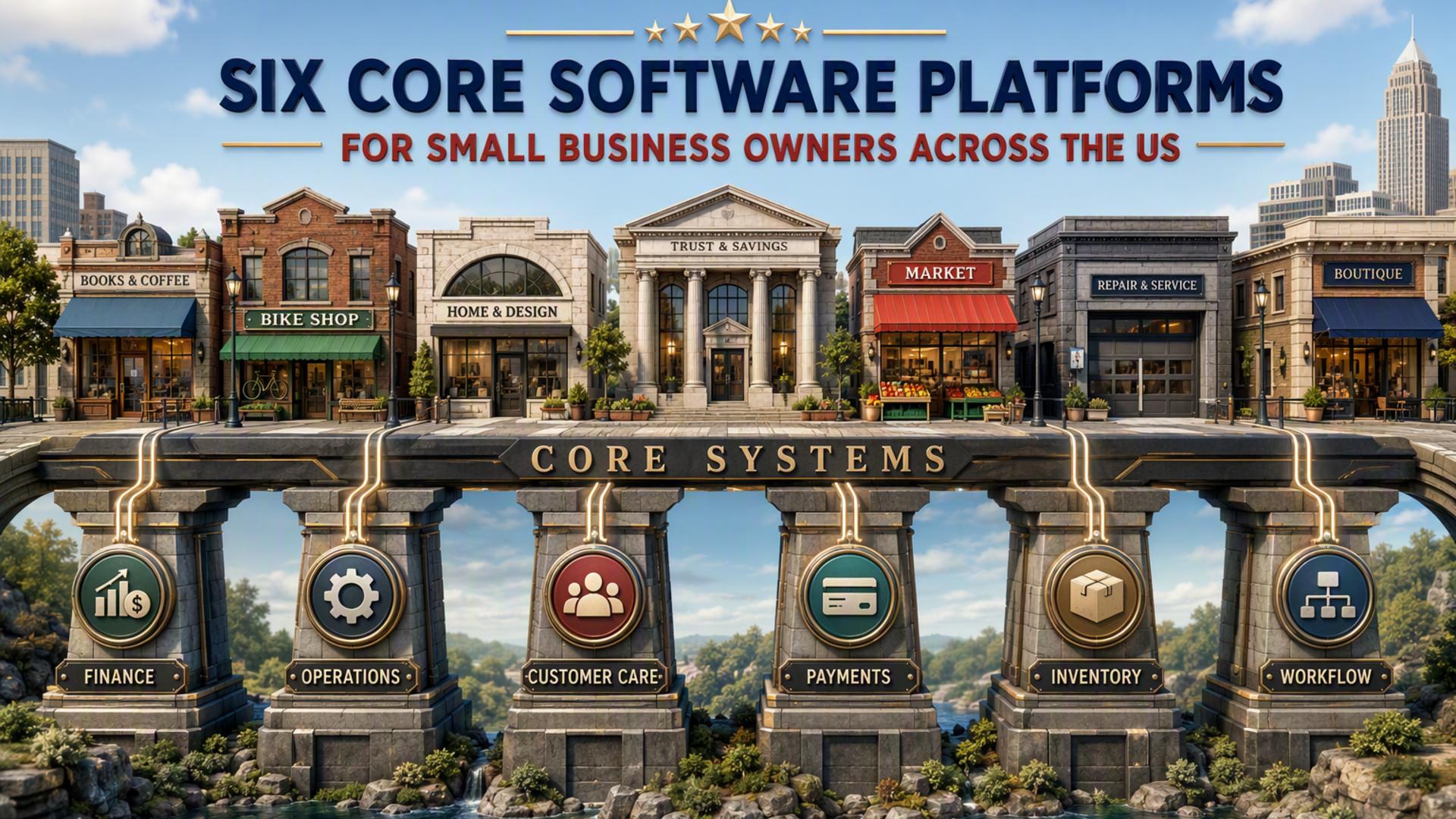
Six Core Software Platforms for Small Business Owners Across the US
Launching and operating a small business in the US can be exceptionally demanding. While the potential rewards are substantial, the workload is equally real. For many owners, there are simply not enough hours to handle every responsibility, so any tool, workflow, or routine that cuts down on mistakes or saves time becomes more than a convenience. It can create a competitive edge.
Sustainable, expanding small businesses are not always built by the owners with the greatest energy or the strongest ideas. Often, they are built by people who choose the right tools and use them consistently. The following six software solutions deserve a place in every US small business owner’s toolkit.
1. Sage: Software for Accounting and Financial Management
Sage provides the financial base on which the rest of a business operates. It records income and expenses in real time, automatically reconciles bank accounts, supports invoicing and payment collection, and gives owners an up-to-date view of their finances whenever they need it. Instead of sorting through scattered records at tax time or relying on a bank balance that does not show the full financial picture, business owners can keep their information accurate and organized all year.
Plans are offered for businesses at every point of development, including solo operators starting and growing small businesses with staff and increasingly complex financial requirements. As the business changes, the platform can grow alongside it, avoiding the need for a disruptive system migration.
Why it matters: Maintaining clear and accurate financial records throughout the year supports confident decision-making while making the rest of business management simpler and less risky.
2. Calendly: Software for Scheduling
Arranging meetings is often a low-value task that takes up more time than expected through repeated emails about availability. Calendly addresses this by linking with a calendar and enabling clients, prospects, and other contacts to reserve available time directly. Confirmation and reminder emails are then automatically delivered to both participants.
Small business owners who routinely book client consultations, sales conversations, or service appointments can recover a substantial amount of time over a year by reducing scheduling administration. The polished and efficient booking experience can also leave a positive impression on clients.
Why it matters: Automated scheduling eliminates an ongoing drain on time and focus that can add up to significant lost hours over a year.
3. Shopify: Software for E-commerce
For US small businesses selling physical or digital products, a professional online storefront is now essential. Consumers increasingly research and buy online either before visiting a physical location or instead of doing so, meaning that businesses without a credible e-commerce presence may be unseen by a large part of their potential market. Shopify is the most widely used e-commerce platform for small businesses and brings store setup, inventory management, payment processing, and shipping integration together in one platform.
Shopify integrates with accounting software, allowing sales to be recorded automatically and financial records to remain current without manual data entry. For businesses that sell both online and in person, having every sales channel reflected in a single financial system offers an important operational benefit.
Why it matters: A connected e-commerce presence can create additional revenue channels while maintaining accurate financial records without extra administrative work.
4. 1Password: Software for Password and Security Management
Small business owners are responsible for an expanding range of sensitive accounts, including banking, accounting platforms, payroll systems, government portals, client systems, and supplier accounts. Without a password manager, they must either reuse passwords, creating a serious security exposure, or spend time recovering forgotten credentials. 1Password keeps credentials in an encrypted vault, creates strong and unique passwords for each account, and fills them in automatically.
For US small business owners who are solely responsible for their company’s digital security, the account-compromise protection offered by 1Password is especially valuable in relation to its modest cost.
Why it matters: One compromised account can result in financial and reputational harm that takes far more time and money to address than any software tool in this list would cost over a decade.
5. Mailchimp: Software for Email Marketing
For most small businesses, one of the most economical ways to generate additional revenue is to remain visible to people already familiar with them: former customers, current clients, and interested prospects. Mailchimp enables this at scale without requiring dedicated marketing effort every week.
Businesses can configure automated email sequences, recurring newsletters, and campaigns aimed at specific customer segments, then allow them to operate continuously. This helps maintain visibility and encourage repeat purchases and referrals without continued active management after setup. For US small business owners without a marketing team, Mailchimp functions as the nearest equivalent.
Why it matters: Regular automated communication with an existing audience can produce repeat revenue and referrals for a fraction of the cost of acquiring entirely new customers.
6. Gusto: Software for Payroll and HR
For businesses with employees or contractors, accurate payroll management is one of the most important US business obligations. Federal and state withholding, Social Security, Medicare, unemployment insurance, and the related W-2 and 1099 filings must all be managed accurately and on time. Gusto is a payroll and HR platform designed for US small businesses that automates this work by calculating deductions, remitting taxes, and filing required documents automatically.
In addition to payroll compliance, Gusto supports employee onboarding, benefits administration, time tracking, and a self-service employee portal. This replaces a range of manual HR processes with a single platform available to the entire team.
Why it matters: Reliable payroll each pay period, without manual intervention, removes a major administrative responsibility from the owner while reducing the risk of penalties caused by mistakes or late filings.
Frequently Asked Questions
Which software investment should a new small business prioritize first?
For most new small businesses, accounting software should be the first priority because it establishes the financial foundation for every other activity. If accurate, organized records are not maintained from the outset, rebuilding them later can cost far more in time, accounting fees, and potentially missed tax deductions than quality software ever would. Establishing the right process from the beginning is considerably easier than catching up after operating without it.
How do these software tools operate together in day-to-day use?
The key benefit of current small business software is that platforms can connect and exchange data automatically. Accounting software can integrate with payroll, payment processing, and e-commerce platforms, allowing transactions to be recorded automatically wherever they take place. Scheduling software lowers the administrative preparation involved in client meetings, while security software protects access to every other platform. The objective is a compact, connected technology stack in which each tool performs its role well and supports the others.
What monthly software budget should a small business plan for?
For a US small business, a core software stack covering accounting, payroll, email marketing, security, and scheduling generally costs between two hundred and five hundred dollars per month, depending on the selected tools and the size of the business. Time savings alone will almost always recover this investment, even before considering prevented errors, properly captured tax deductions, and revenue resulting from stronger marketing and more efficient operations.
Is cloud-based software a secure place for sensitive business information?
Established cloud platforms generally maintain security standards beyond what a small business can usually achieve on its own locally. Common features of reputable providers include bank-level encryption, automatic backups, role-based access controls, and compliance with applicable security frameworks. For most small businesses, the greater concern is not cloud security itself but the absence of a consistent security practice, an issue directly addressed by tools such as 1Password.
When has a business exceeded the capabilities of small business software?
The strongest indicators include financial software no longer being able to report on the dimensions the business requires, manual processes becoming necessary to close gaps between systems, the finance team spending more effort working around the software than using it, or the business handling multiple entities or complex revenue recognition requirements that small business platforms were not created to support. When these signs occur consistently, it is generally time to assess more capable platforms before the cost of remaining in the current system exceeds the cost of upgrading.
ORDER BOOK FROM